Tagsindustry,
Game Industry Entrepreneurship Paths from Founding to Growth is a project carried out by Neogames Finland ry and funded by the AEL Foundation. The project examines early-stage entrepreneurship in The Finnish Game Industry, business model choices and the conditions for growth.
The report (written in Finnish) looks at why an increasing number of new or small Finnish game companies choose business models that do not primarily aim for scalable growth. It examines this question in a changing operating environment where funding, platforms, distribution channels, discoverability and revenue models are all undergoing significant changes at the same time.
The aim of the project was to identify barriers to growth and business development, as well as structural factors that affect the ability of early-stage game companies to develop, grow and renew The Finnish Game Industry. Another aim was to build practical tools that help companies and supporting organisations identify critical decision points as early as possible.
The report is based on interviews with Finnish game industry entrepreneurs, funders, educational institutions, incubators and ecosystem actors, as well as a project workshop, case examples and background material on the game market, funding and entrepreneurship.
The report and its appendices are currently available in Finnish.
Key findings
A key finding of the report is that the choices made by early-stage game companies cannot be explained by one single factor, such as lack of funding or limited business competence. Instead, they are shaped by the combined effect of several factors: the goals of the founding team, market understanding, funding path, production scope, team competences and how early business-related decisions are recognised.
1. Game industry entrepreneurship should not be viewed as one linear path from idea to growth
Early-stage companies may move towards growth entrepreneurship, profitable and sustainable business, or independent indie-driven development. These paths are not ranked against each other, but their goals, risks, funding logic and support needs differ significantly.
2. Growth entrepreneurship is not the automatic starting point for most early-stage companies
For many new teams, the primary goal is to make a good game, employ themselves, realise their own creative vision or build a manageable business. Growth may be a desired outcome of a successful product, but it is not always a consciously planned or realistic goal from the beginning.
3. Business choices are often made too indirectly
Platform, genre, revenue model, target audience and production scope are decisive business choices. In early-stage teams, however, these decisions are often made based on game development, creative vision or existing competences, without sufficiently early assessment of their impact on the market, funding and growth.
4. Market validation often happens too late
Many game projects progress far before the target audience, commercial potential or market space have been tested sufficiently. This can lead to production, team structure and funding needs being built on assumptions instead of market signals.
5. Funding does not only enable activity, it also steers the company’s direction
Different forms of funding support different business models. Venture capital requires a scalable growth story, publisher cooperation emphasises the commercial potential of the product, public support can help in the development phase, and cash-flow-based development limits risk but slows growth. The funding path is therefore a strategic choice, not just a technical application process.
6. The support ecosystem is strong, but fragmented from the company perspective
Finland has a lot of game industry expertise, education, incubators, networks and funding instruments. The challenge is that these do not always form a clear and continuous path from the company perspective. The transitions from idea to a business-ready plan, from first market signals to the next funding phase, are especially critical.
The project resulted in:
- an up-to-date analysis of barriers to growth, profitability and business development for early-stage companies in The Finnish Game Industry
- a structured view of different game industry entrepreneurship profiles and their support needs
- two case examples illustrating different entrepreneurship paths in practice
- an overview of existing support forms for Finnish game industry entrepreneurs
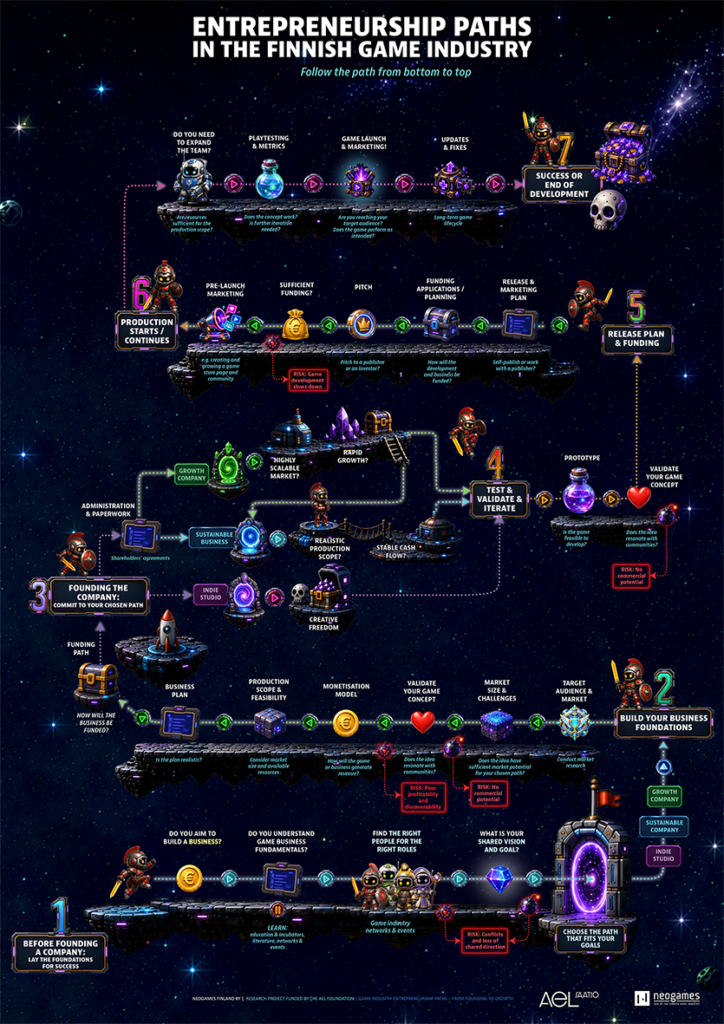
- a visualisation of Finnish game industry entrepreneurship paths, bringing together the key decision points of the report as a practical tool
The purpose of the report is to help game companies, educational institutions, incubators, funders and other ecosystem actors identify early decision points before production, funding, team structure and business model become too firmly locked in.
The appendices include an overview of existing support forms and a visualisation of Finnish game industry entrepreneurship paths. The visualisation brings together the key decision points of the report as a practical tool.
Conclusion
The main conclusion of the project is that early-stage game companies should not be directed too strongly towards one single model of entrepreneurship. Instead, companies should be helped to identify, as early as possible, what kind of company they are actually building.
Supporting growth remains important for the renewal and international competitiveness of The Finnish Game Industry. At the same time, it is important to recognise that profitable, controlled and creator-driven business can be a realistic and valuable path for many companies. What matters is that these choices are made consciously, early enough and in relation to the market, funding, team competences and the company’s own goals.
Download:
Report: Game Industry Entrepreneurship Paths from Founding to Growth
Appendix 1. Existing support forms
Appendix 2. Finnish Game Industry Entrepreneurship Paths visualisation
Please note that the report and appendices are available in Finnish.